Data format
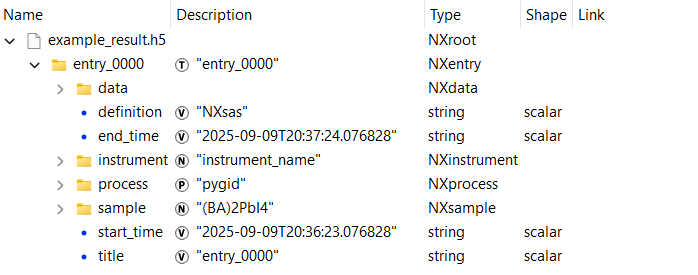
To store individual converted images (datasets) with metadata and experimental parameters within a single file, we employ the widely adopted NeXus format. The data type closely related to GIWAXS/GISAXS data is the NXsas application definition, which was designed for storing small-angle scattering (SAS) data.
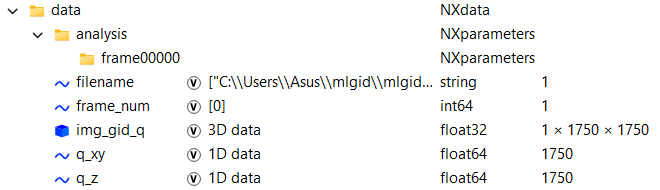
However, we have slightly modified the data group to store arrays of scattering data for motor or time scans, as is implemented in the NXscan definition. An additional analysis group is used to store the results of further mlgid analysis steps. Converted images can be stacked to the previously calculated data arrays if they have the same shape and type, or can be saved in a separate NXentry group.
The naming of datasets for different types of coordinates is shown in tables in Tutorials 4 and 5.
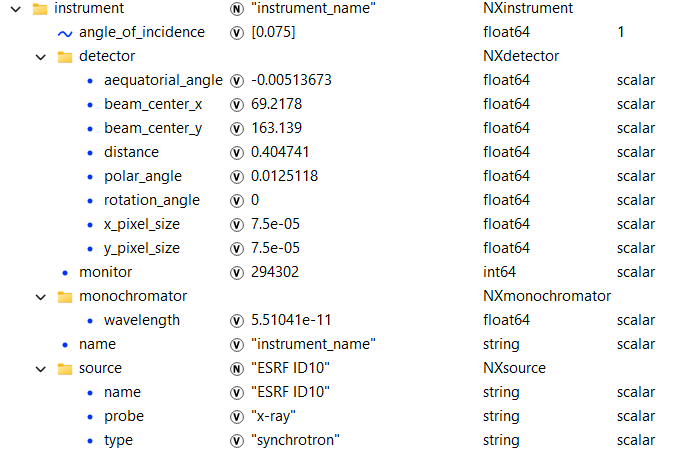
The instrument group contains data from the ExpParams class, following the standard naming defined in the NXsas format — see Tutorial 1.
Additional information about the experiment and source can be added using the ExpMetadata class — see Tutorial 6.
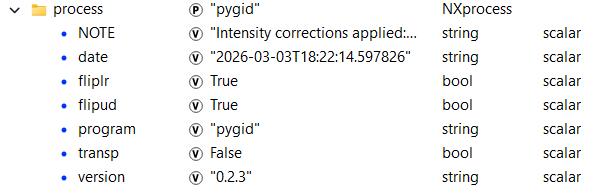
Details of the transformation, such as the date and the applied intensity corrections, are stored in the process group.
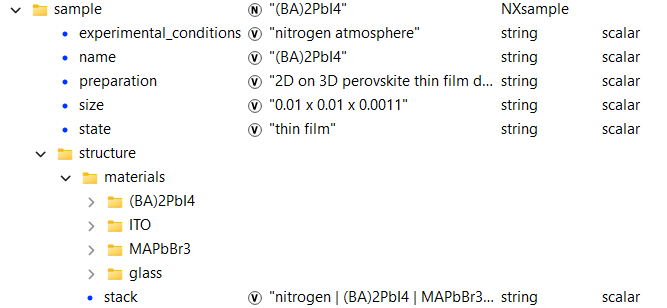
The sample group stores the sample-related metadata — see Tutorial 6.
After saving, the data can be visualized using silx view or obtained using pygid.NexusFile class (see Tutorial 11) or h5py package.
Below is an example of the file structure generated after conversion:
entrygroup(s)
Main
datasubgroup containing image(s) and corresponding axes
instrumentsubgroup containing experimental parameters and metadata
processsubgroup containing conversion details
samplesubgroup containing sample metadata describing thin-film layered structure